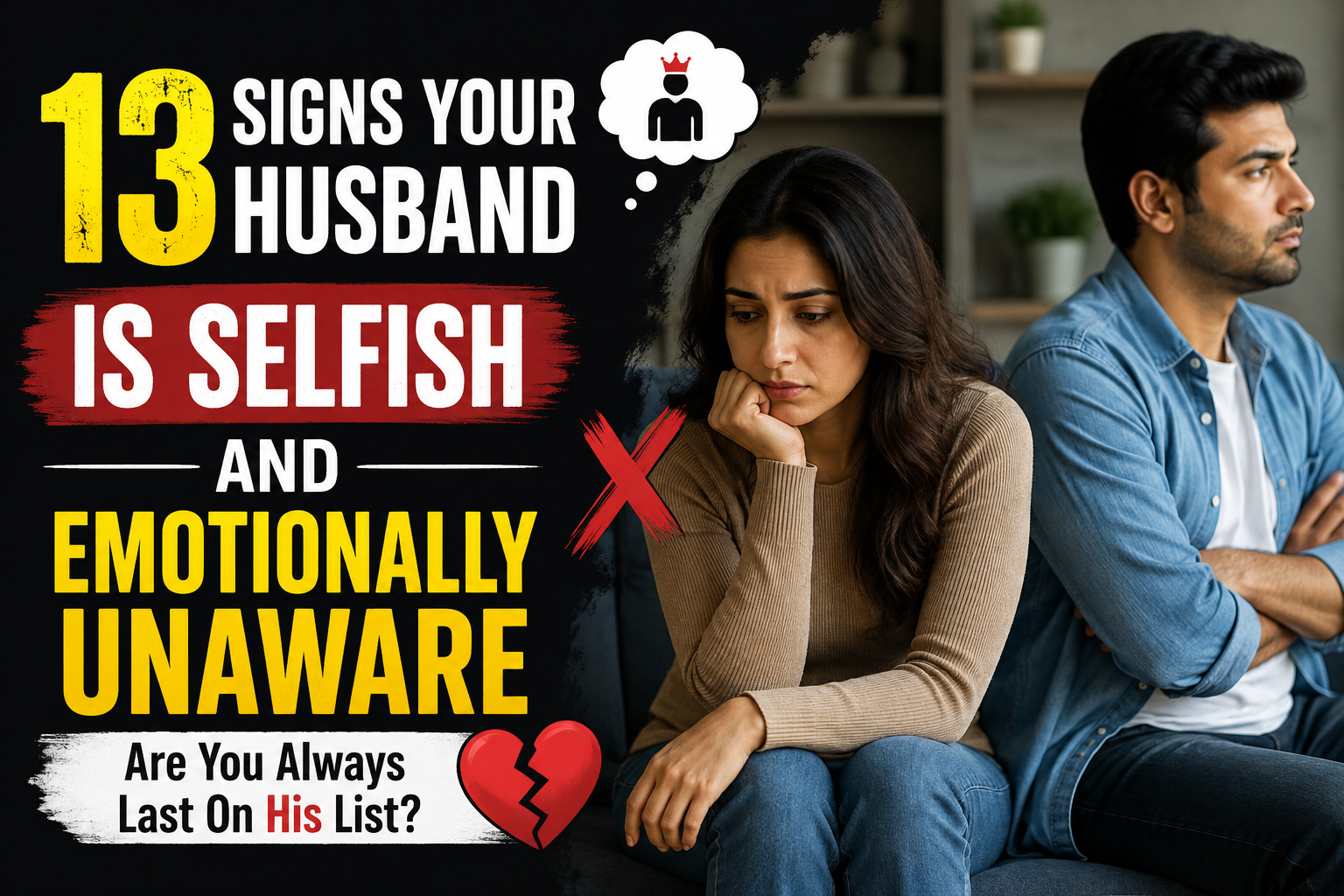
Marriage is supposed to be a partnership where both people feel heard, respected, valued, and supported. But when one partner constantly focuses on his own needs, emotions, and priorities, the relationship can begin to feel surprisingly lonely.
Having a selfish husband does not always mean he is intentionally trying to hurt you. Sometimes, selfish behavior comes from poor emotional awareness, unhealthy relationship habits, difficulty communicating, or simply never learning how to consider a partner’s emotional needs.
The problem begins when these behaviors become a repeated pattern.
You may start wondering why you are always the one initiating conversations, solving problems, managing the household, offering emotional support, or trying to keep the relationship alive.
Here are some common signs that your husband may be acting selfishly or struggling with emotional awareness.
1. Every Important Decision Seems To Revolve Around Him
A healthy marriage involves compromise.
But if your husband regularly makes decisions based almost entirely on what works for him, your preferences can slowly disappear from the relationship.
It could involve money, holidays, social plans, household decisions, or even simple weekend activities.
You may notice that he expects you to adjust to his plans while rarely making the same effort for you.
The issue isn’t that he occasionally gets his way. Every relationship has compromises. The concern is when compromise almost always goes in one direction.
2. He Expects Emotional Support But Rarely Gives It
When your husband is stressed, upset, or frustrated, you may be the first person he turns to.
You listen.
You reassure him.
You make him feel better.
But when you are having a difficult day, he suddenly seems unavailable.
He may change the subject, minimize your feelings, become distracted, or tell you that you’re overreacting.
Over time, this imbalance can make marriage feel less like a partnership and more like an emotional support system for one person.
3. He Doesn’t Notice When You’re Struggling
Emotional awareness means paying attention to more than someone’s words.
Sometimes your partner’s body language, silence, mood, or behavior tells you that something is wrong.
An emotionally unaware husband may completely miss these signals.
You might come home exhausted and receive no acknowledgment. You might be unusually quiet and he never asks why. You might be overwhelmed with responsibilities while he continues with his routine as if nothing has changed.
This can leave you feeling invisible inside your own marriage.
4. He Treats Your Time As Less Valuable Than His
Your time matters just as much as his.
A selfish pattern can appear when he expects you to rearrange your schedule whenever he needs something but becomes irritated when you ask him to make a similar adjustment.
For example, he may expect you to handle an errand, organise family plans, remember appointments, or take care of responsibilities that could easily be shared.
Eventually, you may begin feeling that your time is considered “available” while his time is considered important.
That is not a healthy balance.
5. He Rarely Asks About Your Life
Emotional connection grows through curiosity.
Partners who care about each other usually want to know what is happening in each other’s world.
What happened at work?
How did that important meeting go?
Are you excited about your new project?
How are you feeling about something you’ve been worried about?
If your husband rarely asks questions about your experiences, interests, goals, or feelings, you may begin to feel that he knows very little about the person you are becoming.
A marriage can survive different hobbies. It becomes much harder when there is little genuine interest in each other’s lives.
6. He Turns Your Feelings Into An Argument
One of the most frustrating experiences in a relationship is finally opening up about your feelings and ending up defending yourself instead.
You might say, “That hurt me.”
Instead of listening, he responds with:
“You are too sensitive.”
“You always complain.”
“That’s not what happened.”
“You do the same thing.”
Now the original issue has disappeared, and you’re arguing about whether you’re even allowed to feel upset.
A healthier response would be curiosity and understanding before trying to defend himself.
7. He Thinks Household Responsibilities Are Automatically Your Job
A marriage works better when both partners recognize the work required to maintain a home.
That includes more than cooking, cleaning, and laundry.
There is also planning meals, remembering birthdays, arranging appointments, managing children’s schedules, buying household supplies, and noticing what needs to be done.
If your husband waits for you to assign every task, he may technically be “helping,” but you are still carrying the mental responsibility of managing everything.
You shouldn’t have to manage another adult in order to get a fair partnership.
8. Your Needs For Affection Are Often Ignored
Every couple expresses affection differently.
Some people love hugs and physical closeness. Others prefer words, quality time, thoughtful gestures, or acts of service.
The problem is not having different love languages.
The problem is refusing to care about your partner’s needs.
If he expects affection whenever he wants it but dismisses your need for closeness, reassurance, romance, or tenderness, resentment can gradually build.
A strong relationship requires both people to care about what makes the other person feel loved.
9. He Shows Little Interest In The People You Care About
Your friends and family don’t have to become his best friends.
However, basic respect matters.
A selfish partner may constantly complain about your friends, dismiss your family, or make you feel guilty whenever you want to spend time with people who matter to you.
Sometimes the problem becomes even more serious when he expects you to prioritise his social circle while showing little willingness to participate in yours.
Healthy boundaries are important, but isolation should never become the price of being married.
10. Appreciation Is Almost Completely One-Sided
Do you regularly notice what your husband does?
Do you thank him?
Do you celebrate his achievements?
Do you make him feel valued?
Now ask yourself whether he does the same for you.
If you constantly give compliments, encouragement, affection, and appreciation but rarely receive any in return, the relationship can begin to feel emotionally empty.
You don’t need constant praise from your spouse.
But everyone deserves to feel noticed by the person they share their life with.
11. He Avoids Difficult Conversations
Some people dislike conflict.
That’s understandable.
But avoiding every uncomfortable conversation doesn’t solve relationship problems.
An emotionally unavailable husband may shut down whenever you bring up an issue. He might leave the room, refuse to respond, change the subject, or simply wait until you stop talking about it.
The immediate conflict may disappear, but the underlying problem remains.
And unresolved problems have a habit of returning.
Healthy communication doesn’t mean agreeing about everything. It means being willing to stay in the conversation long enough to understand each other.
12. He Finds Fault More Easily Than He Gives Credit
Constant criticism can slowly damage someone’s confidence.
Perhaps he notices the one thing you forgot but ignores the twenty things you successfully handled.
Maybe he points out what you could have done better but rarely acknowledges how much effort you put in.
When criticism becomes the dominant form of communication, you may start walking on eggshells.
You shouldn’t have to earn basic kindness by being perfect.
Constructive feedback has a place in marriage. Constant negativity does not.
13. He Doesn’t Believe There Is A Problem
This may be one of the most difficult signs to deal with.
You can clearly see that the relationship is struggling.
You try to explain what you need.
You ask for changes.
But your husband insists everything is fine.
When one partner refuses to acknowledge a problem, the other partner can feel completely powerless.
Remember that you cannot force another adult to develop emotional awareness overnight.
What you can do is clearly communicate your experience, establish healthy boundaries, and decide what you are willing to accept going forward.
What Causes Selfish Behavior In A Marriage?
Selfish behavior can have many possible causes.
Some people grew up in homes where emotional conversations were discouraged. Others never learned how to share responsibility or communicate during conflict.
Stress, burnout, unresolved personal issues, poor communication skills, and unhealthy relationship patterns can also contribute.
However, understanding the possible reason behind someone’s behavior does not mean you have to tolerate behavior that repeatedly hurts you.
Explanation and justification are two different things.
What Should You Do If Your Husband Is Selfish?
Start by identifying the specific behaviors that are hurting you rather than simply calling him “selfish.”
Instead of saying:
“You’re selfish.”
Try explaining:
“I feel alone when I have to handle every household decision myself.”
Specific examples are easier to understand and discuss.
Choose a calm moment rather than beginning the conversation during an argument. Explain what you need, listen to his perspective, and pay attention to whether he is genuinely willing to make changes.
Most importantly, look for consistent behavior rather than temporary promises.
Someone who cares about the relationship may not change perfectly or immediately, but they should be willing to listen, reflect, and make a reasonable effort.
When Should You Consider Professional Help?
If the same conflicts continue despite repeated attempts to resolve them, couples counseling can provide a neutral environment for difficult conversations.
Professional support may be especially useful when communication has completely broken down or both partners feel stuck in the same cycle.
And if your partner’s behavior includes intimidation, threats, humiliation, coercion, or other forms of abuse, prioritize your safety and seek appropriate professional or local support rather than treating the situation as an ordinary communication problem.
Final Thoughts
A selfish husband may not always realize how emotionally exhausting his behavior has become.
But your feelings still matter.
A healthy marriage isn’t about keeping score over every little thing. It is about creating a relationship where both people can give, receive, compromise, communicate, and feel respected.
If you constantly feel unheard, unsupported, or unimportant, don’t ignore those feelings.
Look at the pattern.
Ask for the changes you need.
Set reasonable boundaries.
And pay attention to whether your partner is willing to meet you halfway.
Because marriage should not feel like one person carrying the relationship while the other simply lives inside it.
Frequently Asked Questions
What are the biggest signs of a selfish husband?
Common signs include always prioritizing his own needs, avoiding responsibility, showing little interest in your feelings, expecting emotional support without giving it, refusing to compromise, and dismissing your concerns.
Can a selfish husband change?
Change is possible when a person recognizes the problem and genuinely wants to improve. Lasting change usually requires consistent effort rather than temporary promises after an argument.
Is being emotionally unaware the same as being selfish?
Not necessarily. Someone may struggle to recognize or express emotions without intentionally being selfish. However, persistent emotional unawareness can still create an unequal and painful relationship dynamic.
How do you communicate with a selfish husband?
Use specific examples and “I feel” statements instead of general accusations. Explain the behavior you are experiencing, how it affects you, and what change you would like to see.
When is selfish behavior in marriage a serious problem?
It becomes especially concerning when it is persistent, one-sided, dismissive, controlling, or accompanied by insults, intimidation, manipulation, or other abusive behavior.